Peeping Tom: The Acknowledged Voyeur

Pathe Freres’ 1901, two minute spectacle, Peeping Tom is an early work of cinema that situates itself perfectly, and overtly, within the Gunning realm of attraction. The film exudes in unflinching reflexivity from the very onset as the spectator is presented with the self-aware exhibitionist guiding us through the most intimate of spaces. Voyeurism is not only acknowledged, but also reveled in. Formal elements and filmic devices of the work (such as the mise-en-scene, editing, framing, and score) all serve to extrapolate the notion of voyeurism and the self reflexive exhibition – inherent characteristics representative of the “cinema of attraction.”

The Brechtian nature manifest in Peeping Tom is showcased immediately for the viewer with the protagonist’s breaking of the fourth wall and subsequent acknowledgement of the audience and camera alike. An affinity for the conscious viewer is established and maintained throughout. Tom Gunning solidifies the claim in his essay “An Aesthetic of Astonishment,” affirming that, “This cinema addresses and holds the spectator, emphasizing the act of display. In fulfilling this curiosity, it delivers a generally brief dose of scopic pleasure.” The first, third, and fifth edits are supposed POV shots that, when taken within context of the opening, blatantly instigate the perception of exhibition occurring onscreen. They also tend to subtly implicate, or indict the spectator with every moment of intrusive gazing that takes place in front of various keyholes. Juxtaposition of public and private space, compounded with the self-reflexive, slapstick disposition of the film, all substantiate Gunning’s claim that, “…the scenography of the cinema of attractions is an exhibitionist one, opposed to the cinema of the unacknowledged voyeur that later narrative cinema ushers in.”

The mise-en-scene of the normative public space becomes reminiscent of theatre performance. The recurring view is framed much like the view of a stage, and congruently the players become over dramatized. Confined space, identical doors as the backdrop, and a man suspiciously adorned with maid-like apparel, guides us openly into intimate space of others. It is a performance in three parts: the exhibitionist, the viewer, and those being surveyed. The viewer is justly included because, as is true with Brechtian style theatre, they are consciously involved in their act of looking; they are aware of their role in the context of cinema. As they chose not to remove their eyes from the screen as the POV shots occur, they become intrinsically linked to the “peeping Tom” and, as a result, are just accountable; it is this cognizance that reminds us the patrons of early cinema were not merely, “gullible country bumpkins, but sophisticated urban thrill seekers…” The conclusion of the piece is a surprise to the audience and a return to the light-hearted core of the film that is almost forgot about when peering through exaggerated keyholes. The wardrobe of our peeping tom is also a constant reminder of the vaudevillian performance we are witnessing; it places us in a suspiciously comedic role of witness, not quite able to discern the intention of the filmmaker until the end.

Peeping Tom not only typifies the “cinema of attractions,” it reflects upon the voyeuristic predilection of the industry and cements conventions that would later be elaborated on with the emergence of narrative cinema. The exhibitionist style of filmmaking acknowledges the viewer and invites them into a world of wondrous gazing, a private world of attraction.

Rum Punch to Jackie Brown

Elmore Leonard’s 1992 crime-fiction novel, Rum Punch, is instituted as a masterful framework for Quentin Tarantino’s film adaptation, appropriately re-titled Jackie Brown.   However, an analytical view of the two works reveals many stark, contrasting elements that become analogous with and reveal the workings of a true film auteur. Though the screen version borrows heavily from Leonard’s work in terms of dialogue, characters, and plot, Tarantino’s narrative operates on a distinctly different level- transformed by the implementation of the director’s signature cinematic style. These characteristic elements are revealed through, as well with certain scenario omissions and filmic additions, three significant changes: in location, the shift of central focus/ the remaking of Jackie, and a distinguishing form of characterization, all of which are pieced together expectedly with a cinephilic incorporation of cinematic traditions and specific film genres.

The location shift from Miami to Los Angeles is an integral element cohesively linking all of Tarantino’s work up through the release of Jackie Brown. A setting teeming in Los Angeles subculture is arguably one of the most important aspects of the director’s work, affecting every aspect from dialogue and characterization to mise-en-scene and action. As the narrative shifts locales the characters are presented in a subtle yet completely differing light which is most noticeable through examining both Louis (Robert De Nero) and Melanie (Bridget Fonda). Leonard depicts Melanie as a woman with a “huge ass” and someone “who is thirty but looks much older.” Contrastingly, Fonda’s portrayal of the character is visually and dramatically indigenous to a beach of Southern California.

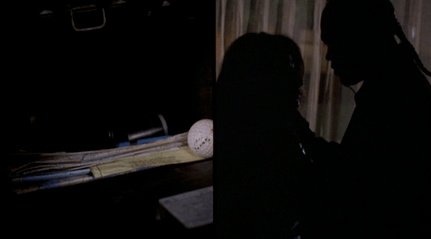
The image below, from a scene completely non-existent in Rum Punch, takes place as Melanie and Louis travel to “The world’s largest indoor shopping complex,” the Del Amo mall. Tarantino brings the viewer’s attention to the enormity and grandeur of the shopping complex and utilizes the events within and surrounding the complex to comment on the woes of the consumer culture of Los Angeles. His depiction is of a world ensnared in ignorant bliss and lost communication. Though Jackie (Pam Grier) is supposedly being watched at all times Nicolet (Michael Keaton) and the other officers fail to be present when it is most imperative and Louis gets lost trying to find his car. The shooting of Melanie is also an important observation in this same context as she is shot twice in the middle of an open parking lot during broad daylight but nobody manages to notice or seem to be capable of caring. In opposition Leonard’s novel specifically makes note of the security presence, stating, “One of those white Jimmy’s was coming up the next isle,” which implements a certain sense of urgency and consequence not apparent in Tarantino’s adaptation. Scenes in cars are rampant and distinctive throughout his films often revealing pertinent information in regards to characters (and their interactions), and time/ place. The choice to substitute Louis’ Toyota for a Volkswagen EuroVan works towards solidifying the film’s place in not only Los Angeles subculture but integrating characteristic elements of pop culture as well (with the choice of car and also his use of popular music in the scene- in this instance “Midnight Confessions” by The Grass Roots). This film is also littered with these characteristic car scene sequences which Edward Gallafent explains, “is a crucial mediation between interior and exterior in modern experience: the inside of a moving car, offering the chance to allow the outside world to pass at a distance, and sometimes to flee from the threat posed by it.” It is also worthwhile to think of theses two characters in the context of the whole film, which has them smoking an abundance of marijuana almost every time they appear together onscreen. This shift in location also proves to be useful in eliminating characters and unneeded plot extensions such as Renee and Da-veed as well as the encounter with the white supremacists.

WS

The way Tarantino manages to reshape the players of the film elicits his cinematic style and distinctive authorship, which ultimately forms a clear divide between Jackie Brown and Rum Punch. An invaluable soundtrack lends itself to musical associations, which in turn adds depth to many of the characters and their relationships. The connection between Max and Jackie is altered drastically. Peter Travers expounds this notion stating, “The glory of the film resides in the unlikely romance between Jackie and Max. He hears music when he first sees her- it’s Seventies soul, of course. And she introduces him to the Delfonics (Woods p. 146).” Noticeably, the film is void of any extremely sexual interactions between the two. While they flirt back and forth, Tarantino manages to extract a much more personal and intricate examination of their attraction and intentions without any hint of a sexual encounter. The use and repetition of music, in particular The Delfonics, proves to be constitutive throughout the narrative and in character development. Max first hears the song “Didn’t I (Blow Your Mind This Time)” when Jackie plays it for him. From that point on the song becomes a metaphor for their relationship. The song presents allegorical lines like “Didn’t I blow your mind this time” and “Get this into your head, there’ll be no more” which is presented as a foreshadowing dialogue being given from Jackie to Max. This track in particular also provides an arena for Tarantino to parade his distinctive black comedic style that, along with his film “borrowing,” bends the genres of his films and allows for the crossing of spectator boundaries.

Tapes

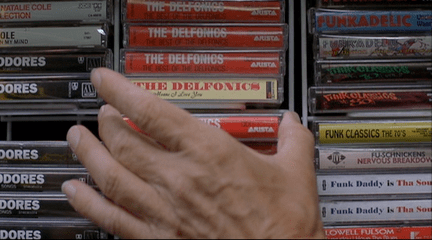
The image pictured above possesses many important elements that showcase a unique directorial style. The purchasing of the cassette tape works further in establishing Max’s character and developing his psyche, as well as the complex relationship formed between him and Grier’s character. His true feelings towards Jackie and his solemn, reserved love-struck demeanor is exposed to the spectator while providing the aforementioned comic relief. This also reoccurs on a more emphatic note towards the end of the film as Max and Ordell (Samuel L. Jackson) drive to the bail bond office Ordell pressing play and upon hearing the song, remarking, “I didn’t know you listened to The Delfonics,” with Max replying, “They’re pretty good.” Considering the context in which the comment is made, as well as the tension inherent in the climatic situation unraveling, it provides an extremely spontaneous and defining moment of comic relief.

The selection of cassette tapes is also one instance of many allusions and uses of black exploitation throughout the duration of the narrative. Tarantino remarks, “I brought a lot of the feeling of black exploitation films that I like to Jackie Brown. It’s like the debt Pulp Fiction owes to Spaghetti Westerns, Jackie Brown owes to black exploitation films. And the relationship that surf music had to Pulp Fiction, old school Seventies soul music has to Jackie Brown: that’s the rhythm and the pulse of the movie (Woods p.143).” Artists such as The Commodores, Delfonics, and “Funkadelic” compilations are an obvious reincarnation of the black exploitation films of the 70’s that Tarantino adores and remakes in a unique way with this film. Jackie Brown recycles music from Foxy Brown and Coffy, giving a more than obvious nod to Roy Ayers’ work on the soundtrack of the 1973 Jack Hill film Coffy and it is through the integration of these tracks and artists that the influence of black exploitation is most clearly defined and prevalent.

The most significant alteration in the film adaptation is its shift of focus and remaking of the main character Jackie Burke, a small white blonde, into Jackie Brown, a voluptuous African-American women. The most obvious example in this instance comes by way of the shift in title. Jackie Brown implores and forces the audience to shift their focus away from the other characters in the film and draw it to the actions and relations of Brown whereas the title Rum Punch refers to the codename given by Ordell to the money retrieval operation.

The third image, seen below, is a quintessential shot in dissecting issues of cinematic techniques, style, and nuances within the repetoire of the director. The shot propagates constant references, or infusion, to/ of film history and the “stealing,” which seemingly shadows all discussion of Tarantino as a filmmaker. He candidly remarks, “I steal from every single movie made, all right? I love it. If my work has anything it’s because I am taking this from this and that from that, piecing them together…great artists steal, they don’t do homages.” Some instances of this filmic “theft” are much more transparent than others and at times seem to go unnoticed, but the use of split-screen is one subtle element that should not be overlooked. As Jackie holds a gun to Ordell’s “bone” the elements of black exploitation are apparent but tethered together with a page out of Brian De Palma’s catalogue. In an overtly De Palma manner (whose reverting from constant cuts to the large scale use of split-screen in the 1976 film Carrie revolutionized the cinematic device and brought it to the forefront of the Hollywood film industry) the split screen use in Jackie Brown serves to intertwine elements of contrasting film genres to produce an entirely new experience. In a manner very characteristic of Sisters or Carrie, of which De Palma comments, “I felt the destruction had to be shown in split-screen, because how many times could you cut… You can overdo that. It’s a dead cinematic device (De Palma/ Knapp p. 42),” Tarantino employs the cinematic technique in a very reminiscent way that separates the world of film and literature with an exclusively cinematic element of storytelling, one quite impossible with the none visual nature of the novel. The two frames, it is worth to note, are also very characteristic of film noir with their use of dark shadows and dramatic subject matter- another genre which all of Tarantino’s work borrows from in one manner or another.

Split.png

The pieces of story included in Rum Punch and omitted by Tarantino is another element of his extremely conscious directorial style that allows for his film adaptation to take on an entirely new context. In regards to his choices of inclusion he states, “I’m very much a believer that if you’re creating your own universe and your own mythology, you can have no question unanswered. But here’s the thing: I don’t have to answer the questions to you the audience. You just need to know I know the answer.”

In many ways the film adaptation of Leonard’s novel is strikingly similar but contextually they operate on completely different levels, only as a result of Tarantino’s characteristic and arguably unique cinematic style of filmmaking and story telling. Through his use of popular, or at the least, once popular music he is able to add a wealth of depth to his character, their on screen relationships, and the narrative in its entirety all while simultaneously infiltrating the cinema with a copious amount of pop culture and film history references. His “stealing” of genre and film traditions as well as his change in location to a much more personal space allows him to create a completely unique narrative from a very detailed adaptation. It becomes clear through the examination of these repetitive techniques and stylized choices that as an author and filmmaker Tarantino is nothing less than an extreme innovation and perhaps a revolutionary sort of post modernist art.


Works Cited


Leonard, Elmore. Rum Punch. New York: Dell, 1992


Woods, Paul A. Quentin Tarantino: The Film Geek Files. London: Plexus, 2005


Gallafent, Edward. Quentin Tarantino.


De Palma, Brian and Knapp, Laurence F. Brian De Palma: Interviews. University Press of Mississippi: 2003

http://books.google.com/books?id=nZpkTAxWu4EC&pg=PA42&lpg=PA42&dq=de+palma+split+screen&source=web&ots=B0Csbs1INy&sig=miImz5fzTwTjjgLbYFusqjNvhuc&hl=en&sa=X&oi=book_result&resnum=6&ct=result#PPA42,M1

“The Ever Amalgamating Cinema:” Tsui Hark and Peking Opera Blues

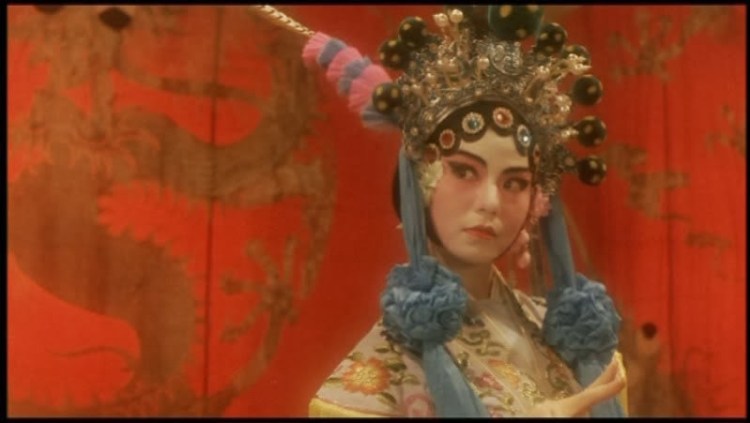
apekingoperabluesPEKING_OPERA_BLUESIt has been argued that Tsui Hark “epitomizes the lost promise of the New Wave,” as it relates to Hong Kong Cinema, but to imagine an Asian film market without his pragmatic and fervent compositions would leave an insatiable void. Brooding in excess, extremes, and Hollywood appropriations, Tsui almost single handedly transformed his nations New Wave cinema into a marketable product that would pave the way for westward expansion. His distinctive approach to the medium is manifest within continuing amalgamations of, not only cinematic conventions, but historical, cultural, and political representations as well. Peking Opera Blues (1986) typifies Tsui in its precise synthesis of genre, aesthetics, and thematic scopes that when melded together prove to be an eclectic piece of cinema. An auteurist approach coupled with pop sensibilities and aesthetics, results in a brand of curb appeal previously mastered by Hitchcock that segued to Tsui Hark and eventually wound up in the hands of Tarantino.

Stephen Teo reciprocates the idea of Tsui’s elemental synthesis stating that his body of work constitutes, “a cinema that integrates the aesthetics of avant-garde pop styles and the commercial instincts of genre cinema.” Though his claim should not be repudiated, it deserves to be expatiated. Integration of a Hark film does not end, nor begin, with simply combining abstract aesthetics with “instincts of genre.” Integration and amalgamated properties exist within each category themselves. From Drama, to musical, and comedy to action film, Peking Opera Blues spans over a minimum four genres, which not only works toward broadening the potential base of spectatorship, but when taken in consideration with the localization serves to extrapolate the irony inherent with Tsui’s expanding art. This style of quasi-sporadic genre weaving is a signifier of thematic juxtapositions and historical allegories waiting to be excavated from the films subtext.

Within the film’s narrative structure the opera theatre functions on many levels. Simply stated it is a relief, a place where identity can be hidden, and gender mistaken; inevitably it is a place for all worlds to collide. Bordwell remarks that, “Tsui treats the opera house as a crossroads of political and personal destinies,” which becomes more and more intertwined as the film progresses until finally it erupts in confrontation.   The theatre is an arena where all social and economic classes collide in filmic metaphor. General Tsao represents Chinese imposition, Brigitte Lin and Sally Yeh’s characters are not only female heroines in a time when woman were never equated with power but also they are symbolic of the newer generation and revolutionary thinkers. These two in opposition are surrounded by crooked ticketing officers and a mass of common people who take absolutely no part in resolving conflict within the theatre- instead they uniformly fall to the ground, afraid to stand up for either side. These are clear-cut allegorical devices implemented by Tsui to construct a commentary on national history that can still resonate pertinent with Hong Kong today, and when combined with intricate choreography, vivid chromatic palates, and gender bending instances the film becomes a meticulous work seamlessly combining sociopolitical contexts and engaging visuals that can appeal to a mass market audience. It must be noted that the reversal of gender roles in Peking Opera Blues is a device employed to entertain and masquerade; not of a sexual political agenda but as Teo notes, “a kind of wicked metaphor for universality.” He goes on to substantiate this notion stating that, “the transmutation of gender is part of (his) quest for identity and nation inherent in the query ‘what is jianghu?’”

The finale of the film harkens back to the opening sequence of costumed theatre and painted face as a way to bookend the narrative. In regards to the epilogue Bordwell claims that, “any prospects of forming romantic couples dissolve into political turmoil. The sword-and-steed woman, now literally on horseback, must go separate ways.” Bordwell, however, fails to mention the ambiguity prevalent within the films resolution and its direct correlation with Tsui’s style. Though the conclusion does evoke unrest and notions of political turmoil it is contradicted by contentment; it then becomes a pristine example of the filmmaker’s penchant for amalgamations and business savvy meditation on the necessity that cinema become universal in its content and consumerist appeal alike. This ability to appease the senseless spectator and critic alike is precisely what epitomizes the distinctive diegetic realm of his films.

The Perfect Illusion: Bicycle Thieves as Pure Cinema

Bicycle-Thieves-1600x900-c-default.jpgThe end of the Second World War brought about a conflicting cultural, social, and political renaissance to every civilized part of our planet. While the United States progressed towards a period of substantial economic boom other countries were left to pick up the pieces, trying to reconstruct disheveled economies and shattered spirits. Cinema, as we have come to understand it, has been and always will be an outlet for not only creative expression but progressive sociopolitical commentary as well. Italian cinema subsequent to the fall of Mussolini is no exception. Left with a “vacuum” in the industry and facing prodigious problems of reconstruction Italian filmmakers attempted to move away from every convention established by Hollywood and the “white telephone” films generated by the fascist regime. With Roberto Rosellini’s 1945 film Rome, Open City the neorealist movement began its upheaval of the purely spectacle, fantasized versions of reality that had been exhibited so prominently before, and continued until the 1952 release of Vittorio De Sica’s Umberto D (though it would be fair to argue that Fellini’s film La Strada, released two years later, is a more than sufficient example of neorealist filmmaking). However, the most abundantly pure and verifiable example of this movement, devoted obstinately to the power and effect of realism, comes to grand fruition in 1948 with De Sica’s Bicycle Thieves. While the film utilizes all conventions characteristic of the movement such as non-professional actors, location shooting, documentary style filming, everyday subject matter, and anti-fascist political ideals what sets it apart is its much deserved classification as the first example of pure cinema. Through many subtleties the narrative aesthetic becomes fixated within a realm of unsurpassed and uncompromised realism that seemingly delineates the woes of post-war Italy without any overt symbolism or grandiose filmic devices or coincidences. De Sica seamlessly constructs a world that while at its core is still spectacle, lets the viewer revel in a realm cinematic reality that becomes the closest embodiment of truth film has to offer.

Andre Bazin summarizes De Sica’s unrivaled feat in perfect words:


De Sica’s supreme achievement, which others have only approached with a carrying degree of success or failure, is to have succeeded in discovering the cinematographic dialectic capable of transcending the contradiction between the action of a “spectacle” and of an event. For this reason, Ladri di Biciclette is one of the first examples of pure cinema (1).


One thing that makes the film such a substantial benchmark in world cinema is its consistency, its perseverance to stay to true Bazin’s statement from beginning to end. Every scene throughout is meticulous in its representation of 1948 Italy and the ordinary life. Within simplicity and the mundane hibernates the beauty of what is being created. The scene in which Antonio is discussing his need for a bike with Maria is a perfect representation of neorealist filmmaking and the notion of a “pure cinema,” not only because of its void of the extraordinary but because of its consummate representation of space and time. One might argue that the cuts remove the spectator in drawing attention to the world of film, but to make any claim like that would presumably be under some sort of voyeuristic pretense. What those carefully placed edits ultimately provide to the viewer is a continuation of events rather than spectacle. They do not displace any time or space, as they are all congruent to the action that is taking place during what is a pretty substantial lull in conversation between husband and wife. As Antonio and Maria enter the door the shot cuts with perfect continuity and does not cut again until it is forced to continue the event as it progresses through the space of their apartment and into another room, never removing itself from one continuous time frame during the scene and consequently not allowing the viewer to question whether or not the events may be operating apart from one another. In discussing the importance of simplistic and “accidental” elements that cement the outright banality that is the foundation of this film it becomes imperative to examine the lack of what might be termed “sensational” shots. The lack of significance within the framing and camera movement is precisely what renders the film as pure cinema as it is taking no extra measures to step outside the realm of reality to convey a social or political meaning; it exists entirely on its own within De Sica and screenwriter Cesare Zavatinni’s carefully crafted, purposefully unremarkable cinematic territory. Bazin remarks:


If the event is sufficient unto itself without the direction having to shed any further light on it by means of camera angles, purposely chosen camera angels, it is because it has reached that stage of perfect luminosity which makes is possible for an art to unmask a nature which in the end resembles it. That is why the impression made on us by Ladri di Biciclette is unfailing that of the truth (2).


One of the most impressive qualities inherent within the film is its wry critique of post-war Italy. De Sica manages to convey a barrage of social and political messages without every really saying anything about them. Whether it be movement, mise-en-scene, action, or events every occurrence within the narrative may be attributed to mere happenstance.


Even when Italian neorealist films are not explicitly concerned with wartime and postwar issues, their male heroes demonstrate the kind of lack rampant during the occupation and post war period… the humiliation of the male protagonist rests in his precarious socioeconomic status, which invariably prevents him from fulfilling the role of economic provider and protector ascribed to men by the dominant fiction (3).


The “lack” Roberto and Wilson mention is intrinsically imbedded within every sequence of the film. In one instance of feigned hope Antonio appears to have found the man who he believes has stolen his bicycle. For a moment we are left to conjure a false hope as he pursues and eventually catches up with the supposed thief, which culminates, after a police search, with what seems to be the entire community pontificating the mans innocence. Antonio is left once again despondent in his efforts of futility. “Throughout the sequence, the film undercuts Antonio’s agency as male protagonist by subjecting him to the gaze of strangers, especially women and children (4).” The German cap worn by the accused should also be observed as a subtle aesthetic device employed to symbolize the “failed duel with German occupiers.” The army cap now becomes a pristine example of how Bicycle Thieves manages to capture the fundamental qualities of pure cinema as it can easily be attributed to coincidence; it has no overt political meaning, significance, or presence within the film and for that reason it is extremely effective within the realist milieu. Upon examination it is compulsory to observe that all of these incidents are not intertwined but rather occur independently of one another much in the way of a typical day in a person’s life. We are being omitted from obligatory propaganda and manifest symbolism as the filmic world operates on the basis of uncertainty, chance occurrence, and being set up in a narrative littered with ambivalence. Bazin remarks that, “the events are not necessarily signs of something, of a truth of which we are to be convinced, they all carry their own weight, their complete uniqueness, that ambiguity that characterizes any fact (5). “


Even when, for a brief moment, things start to look promising for Antonio and his family there is an omniscient sense within the spectator compounded with subtle detail that alludes to foreboding doom. Any chance that the Antonio and his family seem to have is visually stripped away early on as Maria goes to sell the linens in order to redeem a bike for her husband. Millicent Marcus solidifies this notion:


Any tendency to see the protagonists as exceptions to the impoverished masses is discouraged early in the film when Antonio and Maria pawn their wedding sheets in order to redeem their bicycle from hock. If we think that this difficult sacrifice will be enough to set them apart from the crowd and rescue them from destitution, we are wrong, as a dizzying tilt shot reveals when it follows the pawnshop attendant up to the top of a mountain of shelves filled with similarly pawned trousseau linens. In a later visual essay, Antonio’s story is universalized by the multitudes of used bicycles shown at the open markets on the day after the theft (6).


This constant sense of failure can be seen, and felt for that matter, in the moments leading up to the theft of the bicycle. As Antonio begins to post Rita Hayworth to the final wall there is anguish, a tension associated with his demeanor. He is much too happy and carefree in his work as he attempts to wrestle the creases out of the poster. The audience can see the bicycle situated an uneasy distance away from him as his attention is suspiciously drawn away from it for an extended period of time. Prior to this instance we also see him abandon his bicycle in the hands of young children while he follows his wife to the fortuneteller. It is a series of events escalating in such a fashion that viewer is left in perpetual suspense, resulting mostly as a result of the film’s title. This may very well be the singular flaw of the films cognitive basis pure cinema as it alerts one watching to be conscious of the fact a bike will be stolen, and though it may very well refer to Antonio’s actions during the summation of the film, any decently intelligent viewer would be able to deduce almost immediately that Antonio’s bike must be stolen at some point out of pure necessity for the events to unfold and for the film to even exist. As it stands the title is the one thing that subverts the uncanny realistic nature of the diagetic world.

The beauty of pure cinema inherent within the film is that it wholly trusts the spectator to make proper summations and ask questions with almost no information being spoon fed by the filmmaker; it makes certain to necessitate the sagacity of its viewer. Bazin remarks that, “it is our intelligence that discerns and shapes it (social thesis), not the film. De Sica wins every play on the board without ever having made a bet (7).” It is precisely this trust in the audience that lends itself to extreme realism. In pure cinema, as in real life, there are not extremely fantasized sets, wardrobes, or unbelievable events occurring all the time. Bazin reiterates commenting that, “the film shows no extraordinary events… There are no crimes of passion, none of those grandiose coincidences (8).” The simple fact that there are no professional actors (especially in a film made by such a prominent one) is a big part of why the social position established by De Sica and Zavatinni is able to envelop the spectator with utter believability. If Cary Grant had been cast in the role as had been suggested to De Sica the film would never have succeeded in originating a cinematic escape based so firmly and effectively in a believable world. This is not to undermine Cary Grant’s acting ability, but rather to state that the verisimilitude would have suffered greatly, or perhaps would not have existed at all, if it had not been for no-name, faceless actors. This device allows for the audience to have free association from the characters rather than thinking back on how good Antonio was as agent Devlin and how he looked so handsome kissing Ingrid Bergman. Instead there is the presentation of the ordinary, the everyday man that we might pass on the street and not think twice about.

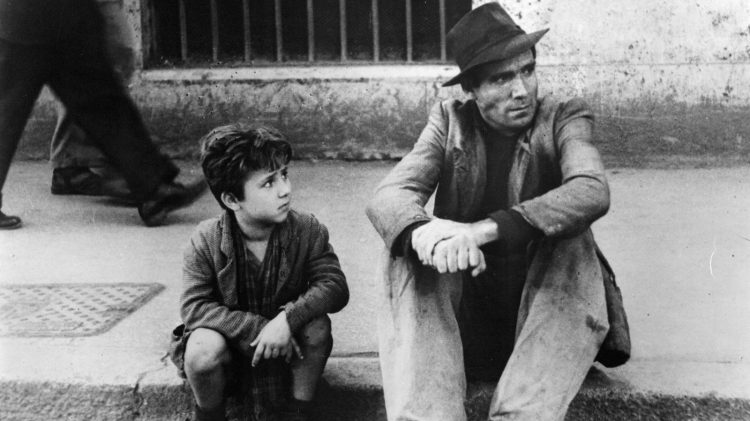
It is said that, “It would be no exaggeration to say that Ladri di biciclette is the story of a walk through Rome by a father and his son (9).” Except for the exceptional plight bestowed upon Antonio a walk through Rome with Bruno is in fact all the film is but this dynamic father-son relationship stands out as a key element in the film. There have been many interpretations as to the nature and understanding of Bruno’s character. Bazin remarks, “it is the child who gives the workman’s adventure its ethical dimensions and fashions” “it is the admiration the child feels for his father and the father’s awareness of it which gives its tragic stature to the ending (10). ” This statement becomes absolutely indisputable when the film nears its conclusion and sees Bruno save what very little dignity his father is left with. Later Bazin says that Antonio has been like God to his son, and in way of contradiction, it seems like quite the opposite in many cases. The child represents the untainted pureness of the human race as a whole; he is capable of seeing the truth and acting appropriately in social situations, quite unlike his father. Bruno embodies a proper moral code that De Sica, through Bruno’s gaze, is asking us as the audience to procure ourselves. “The gaze of the child becomes a cipher for the social order to judge the actions of the male… the male is now the subject of the socially disciplining gaze (11).” As a filmmaker he is presenting us with a force not alienated nor stained by the woes of the adult society. Bruno is the one who fixes and polishes the bike, he takes on an equal role in the search (and a much more levelheaded one), he is the voice of reason when Antonio has none, and he is the one who has a job. Bruno is what Antonio might have been before being unwittingly conformed by his social confine. Marcus counteracts the argument when talking about the boy’s restoration of the bicycle calling it an “obvious projection of his desire to rehabilitate his fathers parental authority (12),” but it seems also fair to consider this a commentary about the purity of children and how, in many cases of crisis in modern society, they act much more appropriately and honestly to whatever situation they are confronted with. This scene implies that Bruno cares for the bike, his job, and the well being of his family members more than his father; it leads the spectator to believe that if it had been Bruno in charge of the bicycle nobody would ever have been able to steal it to begin with because of his watchful and attentive nature.

As we come to define the Italian neorealist movement so do we begin to completely develop Andre Bazin’s concept of “pure cinema.” Essentially what enshrines the Bicycle Thieves as the first proper example of pure cinema is that it was the undoubtedly the preeminent neorealist film. It has essentially been put to the neorealist test, and once it advanced with flying colors, was put through a cinematic purifier that washed it clean of any phantasmagorical spectacle leaving the “thesis of the film hidden behind social reality (13).” The work stands the test of time as it is magically bends and molds to different genres of narrative and documentary, creating a distinctly unique film that reinvents cinema into something that almost isn’t cinema in the least. He has managed to “escape from the impasse, to reaffirm anew the entire aesthetic of neorealism (14).”


Works Cited


  • Bazin, What is Cinema? (University of California Press, 1971)
  • Bazin, What is Cinema? (University of California Press, 1971)
  • Ruberto & K. Wilson, Italian Neorealism and Global Cinema (Wayne State University Press, 2007), 29
  • Ruberto & K. Wilson, Italian Neorealism and Global Cinema (Wayne State University Press, 2007), 37
  • Bazin, What is Cinema? (University of California Press, 1971), 52
  • Marcus, Italian Film in the Light of Neorealism (Princeton University Press, 1986), 66
  • Bazin, What is Cinema? (University of California Press, 1971), 53
  • Bazin, What is Cinema? (University of California Press, 1971), 49-50
  • Marcus, Italian Film in the Light of Neorealism (Princeton University Press 1986), 62

(10) A. Bazin, What is Cinema? (University of California Press, 1971), 53

(11) L. Ruberto & K. Wilson, Italian Neorealism and Global Cinema (Wayne State University Press, 2007), 37

(12) M. Marcus, Italian Film in the Light of Neorealism (Princeton University Press 1986), 59

(13) A. Bazin, What is Cinema? (University of California Press, 1971)

(14) A. Bazin, What is Cinema? (University of California Press, 1971), 49

Freed by Allegorical Infection: The Devouring Consumerism of Zombieland

Zombieland_1

Ruben Fleischer’s Zombieland appears not coincidentally in a time when America is plagued by a recessive economy and battling a seemingly insurmountable debt. The film is littered with verifiable allegories of a crumbling capitalist, consumer culture that aim to satirically awaken the spectator to the decaying vacuous nature of modern society. It manages to present a clever extension and elaboration of the zombie genre with a horror-com twist. While some of the “rules” to survival are clearly a meditation on prior genre customs there are also new interpretations of the patriarchal figure and a rehashing of what constitutes a core family unit. Zombieland is a film that relentlessly tears apart the free market destruction of our society and its values, but like most works that operate with a strong socio-political commentary the message must come under guise; in this case comedy and gore serve to devalue Fleischer’s critique enough to make it widely accessible and for it to potentially go unacknowledged by the average cinemagoer.

From the onset of the film the audience is presented with the defining subtext. The opening frame, depicting an upside down view of the American flag as it waves proudly in front of the Washington D.C. capital building, causes a jarring rumination that is expatiated with Columbus’ opening voice over. He states, “Oh America, I wish I could tell you that this was still America but I’ve come to realize that you can’t have a country without people, and there are no people here.” The camera pulls back and turns upright to reveal heaps of devastation and a zombie adorned in a business suit as he continues, “No my friends, this is now the United States of Zombieland.” The description that follows, detailing how Columbus manages to stay human, is extremely pertinent in consideration with the metaphorical content. Excessive consumption is first marked by the overweight and out of shape, or the “fatties” who are the first to go, and its also worthwhile to note that the infectious zombifying disease started with the ingestion of a contaminated hamburger*.

The evil and depravity of our social institutions are scrutinized by the mere survival of Einsenberg’s character. Survival of the fittest takes on a larger meaning within the narrative, as Columbus is able to sustain himself only because he has had the “advantage” of not ever having any real friends or close family. He is unexposed and ergo uninfected by society and its deteriorating concept of the family unit.

Tallahassee is a man who thrives on useful vengeance. The unrequited love he sustains for his lost son is illustrative of an acceptable family nucleus and his devout pursuit of the Twinkie is yet another allegorical device harkening back to a much simpler time in American history. With the Twinkie employed as a clever McGuffin for the motivation of his character we are reminded time and time again (to), “enjoy the little things.” With the reiteration of this ideal Zombieland becomes not necessarily a plagued place but rather a world of appreciative realizations. Tallahassee’s narcissistic decision to reproduce in such a society however is a major contradiction when considered in conjunction with the rest of the films themes and motifs but can be overlooked by virtue of its genuine nature. As they come to meet Wichita and Little Rock who run a scam on them, quite appropriately in a supermarket, they build a foundation for what eventually becomes a trusting and caring family, not bound by blood or circumstance, but by their own free choice- a choice only obtained as a direct result of society’s disintegration.

Reverting to localization for character names rather than using their given names is another plot device that extrapolates the reoccurring theme of societal structures diverting from the simplicity that made them pure and sustainable. In a post-apocalyptic world the survivors adopt their birthplace as an identifying characteristic just as earlier and more primitive civilizations; without exorbitant overpopulation it becomes unnecessary for them to use multiple or “distinctive” names. Wichita and Little Rock are intrinsically linked to the gender defining conventions of the genre. Their delusionary tactics are forged and melded within stereotypical female genre conventions; wedding rings and misplaced affection are ways for them to manipulate the opposite sex for monetary gain. This is not only an implication of the female but moreover it is a symbolic critique relating to the institution of marriage and its lacking legitimacy. In considering the mistrust associated with them it is also necessary to contemplate the role, however minimal, of Columbus’ roommate 406. When the first intimate contact he has with a female leads to almost being eaten alive it becomes hard for the viewer to sustain oblivious gazing without realizing the implications.

Many other aspects of the film serve to divulge the underlying thematic concepts; infected rushing towards the bright light of a deserted amusement park, survivors completely demolishing a retail store, and even the title of the film all stand as allegorical inferences to be made by the viewer. As with Romero’s Night of the Living Dead (1968) Zombieland operates on a purely allegorical level. Steven Shaviro states in Contagious Allegories that, “The ‘living dead’ emerge out of the deathly distance of allegory; their fictive presence allows Romero to anatomize and criticize American society, not by portraying it naturalistically, but by evacuating and eviscerating it. Allegory is then not just a mode of depiction, but an active means of subversive transformation.” He goes on to state that, “They do not mirror or represent social forces; they are directly animated and possessed, even in their allegorical distance from beyond the grave, by such forces,” substantiating the claim that it is not the zombie or the infected terrorizing the innocent but the social spirit embedded within them.

Though greatly comedic, Zombieland has an undercurrent of terrifyingly real social commentary for the spectator to absorb and contemplate. While utilizing conventions established by past zombie films it also manages to breathe life into the genre with a self-reflexive re-envisioning; It is a foreboding cinematic work that manages to work quite well under a clever satirical veil.


* Note: the two main protagonists are vegetarian (Einsenberg) and vegan (Harrelson) in real life.

“To Love is to Live:” Allegorical relationships in Woody Allen’s Sweet & Lowdown

sweet-and-lowdown

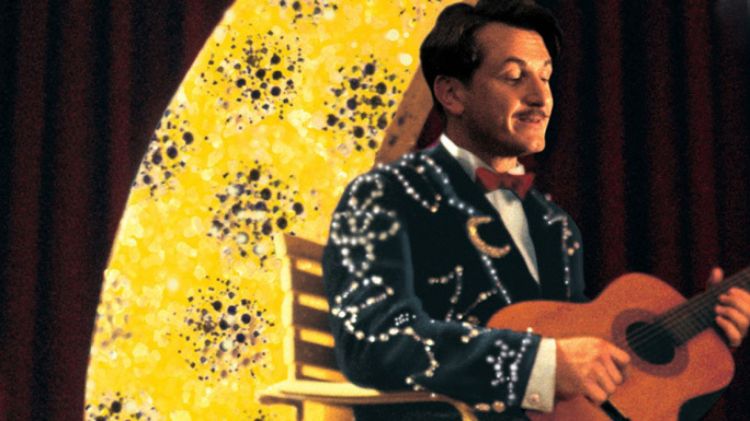
The perplexing art/ life dichotomy manifested in the work of Woody Allen is continually revisited with complex and often paradoxical results. Sweet and Lowdown (1999) is certainly no exception. The film’s narrative/ documentary hybridization focuses on little-known jazz guitarist Emmet Ray (Sean Penn) and his relationships with two different women- Hattie and Blanche. These characters represent a clever cinematic guise employed to explore ideas and ponderings of the filmmaker. Emmet, Hattie, and Blanche are allegorical figures used in narrative form to pose questions about the importance and interrelation of life/ art for the spectator, and perhaps Allen himself. In Sweet and Lowdown the main characters’ relationships expose the artist’s destructive tendencies and represent the detrimental potential art has to replace life itself.

Sweet and Lowdown floats in and out of life with introspective jazz breakdowns littered throughout the film. The ability of Emmet’s guitar stylings to enhance life, or provide temporary escape, is symbolic of what the filmmaker understands as art’s appropriation. At this point in his career Allen has developed a perspective that endorses the melding of art and life, understanding that the two worlds must reconcile for either to be sustained. Hattie and Blanche both understand this, albeit in completely different modes, while Emmet’s realization comes tragically belated. He cries out, “I made a mistake! I made a mistake!” His emotions and existence become relegated to those few records that he, like Django had always done, put his feelings/ life experience into.

Intimate and sexual moments in the film are replaced by Emmet’s guitar playing, the ultimate symbol for the predominance of art over reality and love in his life. Emmet’s first date with Hattie ends in his room where the guitar is already positioned dominantly on the bed. As the scene progresses, the most intimate and sentimental moment occurs after the inferred love making when Emmet plays guitar for Hattie. She stands euphorically frozen in the bathroom doorway, entranced by Emmet’s art and only legitimate form of expression; her orgasmic sensation comes not from Emmet’s sexual prowess but his art. The camera slowly dollys in to isolate her in the frame, it’s proclivity towards Hattie is the filmmaker designating life, no matter how dumb or mute, as the better choice, leaving Emmet to caress his guitar in a way that would better suit a woman capable of reciprocating love and affection. Allen corroborates this stance with Harland and Peters stating, “Films are not my top priority. I want to have dinner with my friends at a restaurant, I want to have a leisurely lunch and not rush through it… I always considered myself a very nice, sweet person, and not an artist. Not a dedicated artist at all.” If this is to be taken as truth, Emmet is a far removal from Allen as a person, and consequently Bailey’s audience/ artist interpretation of Sweet and Lowdown loses some of its legitimacy.

The proceeding scene portrays Hattie as juvenile and in awe of the protagonist’s artistry, a common motif for female counterparts in Allen’s oeuvre. Her sailor-like dress and trademark hat quietly evokes Annie’s wardrobe during her first conversation with Alvy after their doubles tennis match in Annie Hall. Hattie’s devouring of dessert- like Annie’s guileless conversation and reckless driving- are immature characteristics that ultimately become replaced to negative effect. Annie’s eventual maturity and garnered intellect lead to her dismissal of Alvy and his biggest connection to life- love. Blanche is the latter part of Annie that Emmet chooses for her beauty and intellect, this choice generating incredibly detrimental effects. Like Isaac’s decision to abandon sweetness and genuine affection (Tracy) for experience and sophistication (Mary), Emmet has made a mistaken from which there is no return. The film expounds this notion with Emmet’s attempts at dressing Hattie, his remarking to his manager, “She’s like a kid. She loves tearing the paper off the boxes,” and earlier to the drummer, “She’s a genuinely sweet person. I like that- I respect it, but it wont get you anywhere in life.” It is in fact Emmet who won’t get anywhere in life, but rather end up “crying in his beer” because he missed his opportunity to merge art and life. Emmet’s inability to alter Hattie or Blanche in any way is clearly representative of art’s incapacity to control life. Emmet- as an allegory for art- is greatly affected by both relationships, substantially more with Hattie who continues to persevere without art.

After a montage of Emmet and Hattie’s blossoming relationship comes the first and only scene in which Emmet reveals any significant personal information. The instance carries a lot of symbolic weight as it is not only about the lack of paternal love but about how close Hattie has come to Emmet’s art. She is now situated on the bed that the guitar originally was, now repositioned next to Emmet’s with the nightstand removed. But they are still two separate beds with a divide Emmet cannot bridge. His is a world of art and hers of life and love. Hattie’s desire and affection is conveyed with her position on the bed- as close to Emmet’s side as she can be. Hattie patiently waits to be allowed to move over, while Emmet stays in the center of his disconnected artistic realm. Emmet’s original departure from Hattie is a direct result of his art and further disconnect from life/ reality. Because he plays so well a woman, who persuades him to leave Hattie for the night, approaches Emmet. Further removing him from reality Emmet indulges in drugs and alcohol, which not only takes him away from his art (missing the gigs he was scheduled to play) but life (Hattie’s love) as well.

The gloves Hattie gives to Emmet for his birthday are a cinematic metaphor of her love, and subsequently life’s ability to preserve his art. Bailey insists that Hattie is “an embodiment of the audience,” which given her muteness is a fair summation but he fails to make the connection between the audience and reality- in fact the audience is reality, it is speechless love and admiration that, as the gloves denote, preserve art. To connect this birthday gift with an earlier instance reveals Hattie’s attempt to amalgamate Emmet’s art and life. On their way to Hollywood to film the “All of Me” short they are forced to break as a result of a flat tire. Emmet forces Hattie to do the labor while he and Shields relax in the grass saying, “you know I can’t risk my hands.” Her purchasing of the gloves for his birthday symbolizes an opportunity for his art and life to coexist. With the protection of the gloves afforded to him via Hattie, Emmet would no longer have to worry about risking his hands (art) to function in life. But nonetheless he abandons the opportunity, terrified by the prospect of love.

In his book The Reluctant Film Art of Woody Allen Peter J. Bailey remarks, “As for Harry Block, so for Emmet Ray: all weaknesses are redeemed- perhaps even validated- by the fact that he’s an artist.” He goes on to discuss the relationship Sweet and Lowdown shares with Deconstructing Harry stating that, “Allen revisits and reverses that resolution in Sweet and Lowdown, largely through allegorizing Emmet’s dedication to his art as the very attitude that alienates him from the audience which holds out his best hope for salvation. If Harry Block’s life is saved by his art, Emmet Ray’s seems to get sacrificed to his.” In Sweet and Lowdown Al Torrio replaces Larry’s role in Deconstructing Harry. Blanche remarks to Torrio, “With you its like I’m looking into the heart of darkness. Emmet is an artist… he seems to exist in a world of his own.” Her lines recant not only Larry as the devil, but Harry’s alter ego who attracts Faye Sexton and ultimately wins her heart. Faye’s character, like Annie Hall, is essentially Hattie and Blanche assembled as one. Instead of introducing one main love interest and demonstrating her evolution from naïve admiration to an independent realization of the protagonists flaws- and his disconnect from life- Sweet and Lowdown has presented them in two parts with Hattie and Blanche. Faye was never really in love with Harry just as Hattie never really loves Emmet. With not a single redeeming quality it is obviously only Emmet’s guitar playing Hattie is in love with, and Harry’s writing that Faye is attracted to. Bailey says, “Harry’s bitter acknowledgment that life won’t submit to his imagination the way that it does in his fiction constitutes significant growth,” and it is one the continues to evolve with Sweet and Lowdown. Harry Block seems positively resigned to be functioning properly only inside the world of art but Allen has expanded upon that notion with Emmet Ray, a character who wants to function only as an artist. Ignoring the opportunities and emotional sentiments of life leaves Emmet sobbing alone with the pieces of his guitar littering the ground. It is because of his refusal to reconcile the two worlds that Emmet’s art never propels him to stardom and concurrently his life falls apart into myth.

Allen’s oft revisited idea that, “the heart wants what it wants,” is played out in tragic fashion. Emmet clearly does love Hattie: his divulging of his parents fate, taking her to Hollywood, crying out for her in his sleep, a failed attempt at reunion and ultimate breakdown, are all in place for the spectator to recognize that Emmet knew what his heart wanted but decided to sacrifice it for his art. He had begun to accept life when he accepted Hattie, but his egocentric and convoluted ideas of artistry caused him to negate what his heart had wanted. Essentially, what Emmet fails to realize is that both he and his art cannot function without life and love. This is solidified by his breakdown, smashing of the guitar, and the fact that the only recordings of any real value were songs inspired by his heartache. Bailey substantiates this claim stating, “The lesson implicit in the success of ‘Unfaithful Woman’ (is) that art and life are related, that Ann was right in claiming that if he let his feelings out in real life, his music would be greater.”

Bailey is wrong, and in contradiction with himself, when he claims that, “Hattie’s terminal removal from his life does not in itself nullify Emmet’s chances of experiencing satisfying artistic achievements.” In fact it is the very night in which he learns of Hattie’s marriage and new life that he goes on a drunken bender and decimates his guitar. Allen and Pickman both make it clear that nobody knows what happened to Emmet Ray, and indeed that he “may have stopped playing altogether.” It would seem very unlikely that Emmet would be able to “experience satisfying artistic achievements” if he had abandoned his craft altogether. Satisfaction for a small group of jazz aficionados seems likely, but most certainly not for Emmet Ray himself. Even if in his last few recordings Emmet managed to surpass the greatness of Django, art has now replaced life. Emmet is resigned to disintegrate into folklore and jazz legend.

Emmet’s early conversation with Ann- while burning the moon- foreshadows the rest of the narrative progression. She says “You keep your feelings all locked up, and you can’t feel nothin’ for anybody else.” Ultimately this inability is what prevents him from becoming a star on par with Django Reinhardt and also what prevents him from accepting life. Instead, for Emmet, art replaces life. The only real thread of him lives on posthumously in his art. As Bailey says, “Emmet Ray vanishes into his recordings, his music usurping his life,” and noticeably these recordings come after his traumatic relationships where, “something just seemed to open up in him.” In Sweet and Lowdown Hattie’s character is an allegory for what Emmet needs. She is the love and life that can offer Emmet something more out of reality than just shooting rats at the dump or watching trains go by. Blanche is a sort of femme fatale who offers a compromise of art and life that cannot coagulate with Emmet’s unmitigated artistic desires. In fleeing from the one opportunity for reconciliation in Hattie, Emmet has figuratively died by the close of the film, only to be retained within a few rare recordings.

Vivre Sa Vie: The Metaphysical Realm of Tableaux Twelve

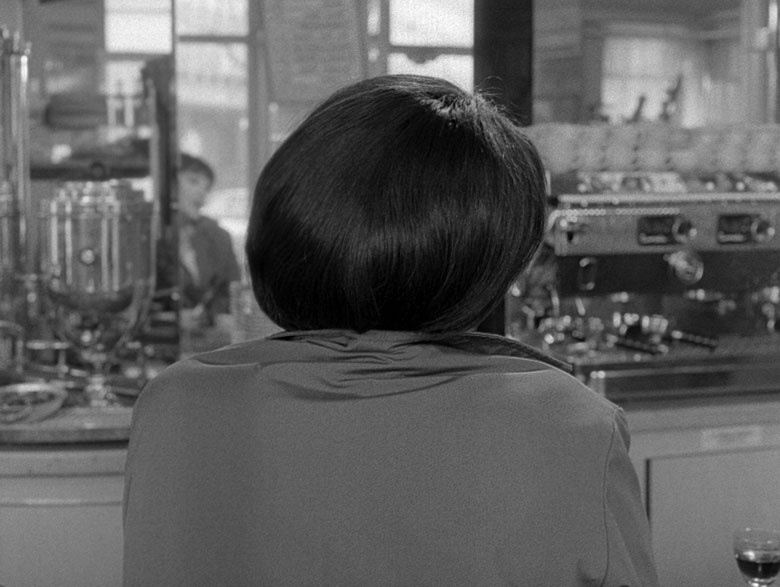
Following D.W. Griffith’s 1915 groundbreaking feature Birth of a Nation world cinema, in large part, became confined to certain conventions, seeming to skew itself into mindless entertainment. During World War II the industry had been misshapen by an infectious formula littered with political propaganda and fantasized realities. The years preceding the end of the war left a void to be filled: a yearning for a revitalizing and introspective look at the world of filmmaking, which was to ultimately be filled via the French New-Wave movement. Jean-Luc Godard’s third feature, Vivre sa vie (1962), stands arguably as the single best example of non-conventional, socio-political filmmaking from the countless threads of New-Wave artists and their respective work. Within his spontaneous and overtly Brechtian style of filmmaking Godard brings the spectator into a metaphysical realm illustrative of 1962 France. He finds a way of relaying a message via image composition and philosophical conversation as opposed to conventional narrative forms. Through a close analysis of the twelfth and final tableaux in Vivre sa vie it becomes apparent within such filmic devices as his choices in framing, mise-en-scene, camera movement, dialogue, and audio tracks that the content of the film is not only a meditation of de Gaulle’s social construct in France but concurrently film history and the language of a people as a whole.

The intrinsic value of Godard’s filmmaking lies not within its social commentary but rather his constant augmentation of form. As Colin MacCabe states, “Throughout Godard’s early films the search for a form of politics is also the search for a form of cinema which he could discuss politics.” (1) Thus it would only seem appropriate to first address the inter-title sequences, which preempt each segment of the film, and the significance of their usage. Each is presented through a fade to black separation intertwined with text indicating to the viewer what is to subsequently follow those tableaux. As Steve Cannon points out, “Godard was seeking to create a space between the images, a resting point, a point of reflection which is where this technique meets up with its Brechtian roots (2).” The twelfth tableaux, entitled THE YOUNG MAN. “THE OVAL PORTRAIT.” RAOUL TRADES NANA, tends to be one of the more ambiguous separations of these episodes as it does not itself foretell the inevitable fate of Nana, but any sort of critical thought applied to the tableaux and the context of this film as a whole will reveal the foreboding demise of Nana much before we get to see it happen. Taking into consideration the continuous downward trend of Nana’s well being and the fact that Godard relays to the audience that the film will be presented in twelve parts before it even begins is the first indication of where this final segment will draw its conclusion. Even more pronounced are the undeniable foreshadows to this event woven within the diagetic sound, his references to earlier cinema, and the characteristically undisciplined dialogue of the ‘players’ in the film. Douglas Morrey touches on all these bases:

There may be no title actually announcing Nana’s death at the end of the film, but commentators have suggested that this death is foreseen in the earlier gunshots, in Nana’s identification with Joan of Arc, in her earlier comment ‘I’ve had enough, I want to die’, in the account she hears of Porthos’s death, or in the quotation from Poe’s ‘Oval Portrait’ (3).


This infusion of Brechtian and Bressonian style filmmaking through narrative separation is acts as a jumping off point into the unique world of “documentary fiction” presented in Vivre sa vie.

Enter ‘The Oval Portrait,’ a story of an artists neglect of his wife in favor of her painted portrait, and Godard’s self referential ‘admission of guilt.’ The scene opens without the typical fade from black and cuts straight to the young man reading the complete collection of Poe as Michel Legrand’s lamenting score continues to run through. The man and Nana exchange words but the audience gets them via subtitles which becomes especially significant when we finally do hear a man’s voice and finally find that ever present fade to black. It brings yet another self-reflexive divide into the film, though this one carries much more weight to it. The voiceover reading of Poe is extremely significant in that the story itself represents the obsessive and destructive nature of capitalism, albeit in a roundabout way, while simultaneously expressing a prudent admission of guilt on behalf of Godard to his wife Anna Korina (Nana), and the audience conjointly. Morrey reiterates stating, “Godard appears to blame himself for neglecting his wife in the pursuit of his art, for caring more about Korina’s role in his films than in his life (4).” This act of admission gives a glimpse of a hypocritical Godard who is constantly, though often through subtle uses of Hitchcockian ambiguity, criticizing de Gaulle’s 5th Republic and the capitalist, consumerist nature that Europe has adopted after the war. He is also mindfully critical of the changing role of woman in society at this time. In this instance however we obtain a likening of Godard to ‘Nana’s pimps and clients through’ through the director himself, as they all ‘use her body for their own ends.’ Colin MacCabe makes good note of the socio-political nature of how Godard represents a woman’s sexuality:

As observer of woman as image and analyzer of the molding, masking process evolved by consumer capitalism, Godard is acute and rigorous. His consciousness of image as cultural product, consciousness of himself as part of and torn by cultural traditions, gives him an awareness of the levels of meaning that the image of woman has acquired in history like the grime on an ancient monument (5).


Because he chooses to make a profitable living with this style of filmmaking he has become somewhat a slave to the capitalist dogma, which he spends most of his time pontificating about throughout the rest of his work. It is a rare occasion where the director is brought down to the level of the audience and criticized. The first part of this tableaux is overall the most overtly self reflexive and Brechtian of any in the film as Godard addresses his known relationship with his actress directly through the words of Poe stating, “It’s our story, a painter portraying his love! Shall I go on?” The story is an affirmation that if one becomes too involved with the artificial they are bound to neglect the real beauty of human life and relations. The scene fades away from Karina’s Joan of Arc inspired Nana, framed in a stunningly close manner to the description uttered by Godard in his recitation of “The Oval Portrait,” and comes back into the narrative realm of the film once again marked with subtitled conversation and Legrand’s inspiring accompaniment.

The next scene beings with Raoul roughly shoving Nana across the pavement “criticizing her for not accepting ‘anyone who pays’ as a client. ‘Sometimes it’s degrading,’ she protests, still clinging to her elusive dignity (6), yet again another jab at the materialist and monetary obsession that seems easily to engulf the human mind and soul. The ‘elusive dignity’ that Sterrit recalls is comprehensive to all who operate within that type of social construct who are lead to believe, or foolishly believe that they are free to make their own decisions. As Nana enters the car with all of the pimps and hoods we are reminded of that fact that her “feminine mask is the passport to visibility in a male-dominated world (7), in this context meaning that her sexuality, along with all the other prostitutes, models, actresses, and so on are all degrading keys to power for the dominating male society. Next we get the final real documentary-like sequence of the film, as there are sprawling shots of 1962 France from what is assumedly the car they had entered in the previous scene. Conversation continues while the audience revels in what becomes a visual and aural document of history. A pinnacle moment while driving to the site of Nana’s exchange comes when their car passes a cinema playing Francois Truffaut’s classic of the same year, Jules and Jim. This moment realized within the context of the film is Godard wryly-critiquing Truffaut’s New-Wave leadership, essentially labeling him as a self-indulgent consumerist for his narrative filmmaking. Morrey draws attention to this important fact:

This is more than a light-hearted dig at Truffaut. The line has the authentic ring of Godard’s films of the late 1960s and early 1970s in which he angrily dismantled the empty promises that the leisure economy makes to the working classes (8).


Morrey, however, takes one small aspect of this remark too lightly in that he does not properly consider the source: A hood, a criminal, and pimp. Because it is derived from such a person it must be questioned why Godard would allot such insight to this type of character. It is most certainly a commentary centered on the ignorance of those in political power, those with the ability to change the social status of the people too impoverished to go to the cinema. The pimp is presented as a product of his environment allowing him to correctly assess the situation in such a matter-of-fact way. Though he is a criminal he understands the destructive nature of the societal confine established by the 5th Republic. After fully taking in the nature of that brief commentary it leads to a simple conclusion; if all of the characters in that car had more money they would not be situated in a position to commit murder nor become a victim of it. One small comment seemingly encapsulates Godard’s Marxist belief. The entire drive through these thriving streets of Paris gives us no glimpse of anyone in the vehicle. They are in constant conflict with this other world and only once visualized as they enter a much more quiet, baron landscape. Here is the metaphysical presented through mise-en-scene and the switching of scenery as the spectator is forced to draw conclusions of the ‘inward’ while only being given the view of the ‘outside’. This is by no means the best example of the metaphysical nature of this film, or perhaps even the tableaux, but it is a unique one that should be considered in conjunction with Godard’s break from cinema conventions, summed up with another statement made by MacCabe:

What was necessary was the disruption of the traditional organization of Hollywood cinema so as to investigate how images found their meaning within specific articulations determined by ideological and political struggles and to engage the film viewer in that investigation (9).


As the setting becomes dreary there are iron gates with the name “Hell & Sons,” the last foreshadow he offers to Nana’s fate. The vehicle finally rounds a corner and comes to a stop in front of another location labeled ‘Restaurant des Studios.’ Most certainly a reflection on how popular cinema is nothing more than an idealized fantasy and subjection of woman, quite unlike the documentary style cinema verite of Vivre sa vie. It is also interesting to note that this twelfth and final section is not only a reflexive commentary on, but also a foretelling of how Godard and Korina’s relationship will eventually play out. The final instance emblematic of the capitalist system and comes with the shooting of Nana. Human life and wellbeing literally takes a back seat to Raoul’s monetary mindset. As she curls up and dies all alone on the pavement “Godard’s camera makes a final abrupt gesture, moving sharply downward so the cold, empty streets fill the lower portion of the screen (10).” The scenes brings back the ever-present mindful decision of Godard to remake Nana in the image of Dreyer’s Joan of Arc, leaving “A faint materialist echo of the heavenward journey that Joan of arc might have expected (11).” Though nana may have shared Joan’s tears, haircut, profession, and fate Godard’s camera movement opposite that of Dreyer’s are clearly less liberating and hopeful. Nana, like all of the working class players of a capitalist system, has as Brice Parain stated, ‘passed through error’ but not arrived at any truth. Subsequently their fate is tragically intertwined with that of Korina’s enticingly grim demise.

Within this short instance all of the devices that have been utilized throughout the film come into play. Godard’s constant references to film history, Lengrad’s ambiguous score, substantial use of literary and philosophical devices, breaking of narrative conventions, and the self referential Brechtian style cinema all amount to define Godard as the auteur; a philosopher of film who presents an outward appearance to lead the spectator into the questioning the inward motivations of its characters and inevitably themselves. The cinema verite or “documentary fiction” of Vivre sa vie puts us inside a distinctive historical era which, by way of a metaphysical approach, demands the audience to speculate and ponder the meaning behind every scene in the film and the techniques employed by the filmmaker within the context of 1962 France.


Works Cited


(1) C. MacCabe, Godard: Images, Sounds, Politics (London: BFI/MacMillan, 1980)


(2) S. Cannon, ‘Not a mere question of form’: the hybrid realism of Godard’s ‘Vivre sa vie,’ French Cultural Studies vol. vii (1996) pp283-294, 284-85


(3) D. Morrey, Jean-Luc Godard (Manchester University Press, 2005), 42


(4) D. Morrey, Jean-Luc Godard (Manchester University Press, 2005), 44


(5) C. MacCabe, Godard: Images, Sounds, Politics (London: BFI/MacMillan, 1980), 91-92


(6) D. Sterrit, The Films of Jean-Luc Godard: Seeing the Invisible (Cambridge University Press 1999), 86


(7) C. MacCabe, Godard: Images, Sounds, Politics (London: BFI/MacMillan, 1980), 91


(8) D. Morrey, Jean-Luc Godard (Manchester University Press, 2005), 45


(9) C. MacCabe, Godard: Images, Sounds, Politics (London: BFI/MacMillan, 1980), 61


(10) D. Sterrit, The Films of Jean-Luc Godard: Seeing the Invisible (Cambridge University Press 1999), 87


(11) D. Sterrit, The Films of Jean-Luc Godard: Seeing the Invisible (Cambridge University Press 1999), 87-88

“21st Century Distractions for Capital’s Golden Child: ” America’s prefigured contrivance of coalesced art and news media in the work of Walter Benjamin

benjamin_2

The first few decades of the 19th century brought about the emergence of modern photographic processes that augmented reproduction innovation first made viable by the lithograph. Inevitably- precipitated in its powers of mass assemblage only by newsprint- came the advent of filmmaking. Possibilities of a new cohesive culture placed an incredible emphasis on “exhibition value” and transfigured the capacity of art that continues today in a digital sphere. As these mechanical/ technological practices proliferated, outmoded concepts of “aura” inherent of artwork prior, such as painting or sculpture, began to rescind. Walter Benjamin’s notion of “shriveling aura,” delineated in his 1936 essay “The Work of Art in the Age of Mechanical Reproduction,” alludes to replication replacing authenticity and tradition with a shift from cult value to political. In today’s capitalist- or neo-capitalist- epoch, with websites such as Wikileaks confronting issues of mass societal deceit, the proletariat is being presented with a revolutionary “fork-in-the-road” where the optimism of Karl Marx comes in direct contention with Benjamin’s pessimism. The coalescence and blurred distinction of art and digital communications media has now bred a mass culture unaware of the extent to which they are manipulated.

Deciphering Benjamin’s conceptualization of “aura,” as well as “exhibition value,” and rendering their contemporary implications is first step in unearthing art’s transgression to propagandized media in an age of technological reproduction. Benjamin remarks that, “For the first time in world history, mechanical reproduction emancipates the work of art from its parasitical dependence on ritual… the total function of art is reversed. Instead of being based on ritual, it begins to be based on another practice – politics,” (p. 670-71). In this sense art becomes commodity, an artifact no longer unique to an individual in time and space but processed and reproduced for mass societal appeal; the contemplative experience is continuously eroded in favor of the critical. When discussing the spectator identification with the lens rather than the actor in his essay ”Benjamin’s age of mechanical reproduction” Richard Kazis notes that, “The importance of this, in Benjamin’s opinion, is the distancing it forces on the audience. The filmgoer more easily takes on the role of critic, for there is no personal contact with the actor to influence judgments.” Modern society has extrapolated the hybridization of audience and critic with the advent of the Internet and social networking sites. User comments on YouTube videos, Facebook “walls,” Blogspot, and thread posts allow the audience to directly criticize the artist with no concern of repercussions. Implementation of user names, profiles, and avatars instill the illusion that the spectator/ critic is a realistic representation of an individual, but in reality these online personas merely constitute an idealized and fictional construction. The Internet populous is consequently able to cloud their comments with a synthetic identity while simultaneously retaining what they perceive as dignity; behind the artifice lays nothing more than a clever stratagem employed by overarching capitalist powers.

To acknowledge the substitution/ integration of aura with politics would be indicative of communist mentalities like those expressed in Soviet montage cinema. Capitalist approaches, on the other hand, tend towards false impressions by formulating generic cult value and ritual with admiration/ mystification of the artist. Contrasting fascist productions Soviet Filmmakers Sergei Eisenstein and Dziga Vertov operated by, as Kazis stats, “politicizing art, by demystifying the production, the distribution, the form, and the content of art, in an attempt to make art serve the cause of the masses and not vice versa.” His claim is substantiated first and foremost by the creation and inception of montage practices that emblematize the sociopolitical aim of attaining a unified whole made up of individual yet equal parts. American film responds to this withering of aura with, “an artificial build up of the ‘personality’ outside the studio,” (Benjamin, 676). He is referring here directly to the star system imbedded within the classical Hollywood narrative that is “fostered by the money of the film industry.” Today celebrity status has spread virally. Digital video has become so simplistic and accessible that even infants are capable of obtaining a certain level of stardom. In this way the “spell of personality” has been forcibly altered by technological innovation and commoditized to the point where the promise of fame is being packaged with the purchase of a camera and Internet connection. Fraudulent materialization of aura is magnified by various other innovations as well, including streaming video chats to any area of the globe. Interaction on this level denotes the ever-unfolding modification of Benjamin’s “[unattainable] blue flower in the land of technology.” Familiar faces and voices transmitted through webcams may evoke the sense of realistic production, as one might know it to be second nature, but none-the-less they are not authentic rather performances for a public. If aura had been replaced with film production, which still necessitated physical reels/ prints, mechanics, and attendance at the cinema during the 1930’s, any trace left behind has surely subsided in the age of the Internet, where data flows freely and hard materials are obsolete. Recent development and expeditious advancement of quantum teleportation represents a technological advancement that may prove to be the antithesis to aura or paradoxically promote its sustained semblance.

Exhibition value is realized today in news media and information technologies. Art and media have completely merged together to become proponents of propaganda. Benjamin asserts, “by the absolute emphasis on its exhibition value the work of art becomes a creation with entirely new functions, among which the one we are conscious of, the artistic function, later may be recognized as incidental,” (p. 672). Consciously we are aware of news media’s informational intents, which would be recognized as incidental when compounded with insight into ulterior motives and intrinsic propagandizing. In the age of commodity and reconstructed functionality exhibition has superseded artistic value but maintains the deceptive appearance of cult worth. The film industry epitomizes the penchant for exhibition instead of artistic value by subjugating art-house films, designating them to small unassuming cinemas. As a result the unknowing consumer wanders to multiplexes where they are spoon-fed regurgitated material produced only in the interest of capital. Monetary concerns (Hollywood blockbusters, remakes, etc…) have almost completely transcended pertinent socio-political development characteristic of “independent” films’ thematic concepts/ motifs by relegating vital artistic expression to few and far off theaters.

We, like Benjamin’s article, are in a paradoxical state of affairs. Wikileaks liberation of classified “cables” and video clips signifies a temporary impasse for politics and digital communication. Opportunities to revolutionize society, art, and culture are being afforded to the masses but the skewed political agendas of mainstream media aim to subvert the proletariat. It may in fact be this very issue that generates Marxist conditions, “which would make it possible to abolish capitalism itself (p. 666),” or once again the masses will be subdued by a government and economical system that has been continually utilizing media to distract and quietly sway opinion. If this revolutionary occasion is not seized it will be on account of “illusion-promoting spectacles and dubious speculations (677),” practiced by dominant forces. Wikileaks founder Julian Assange has lifted the veil to reveal news media’s unbalanced politicized nature. Online publication of these cables has sparked incredible controversy, undoubtedly because they have proven to what extent government bodies will go to- with media as its unseen surrogate- in the name of preserving deceptive authority. Paradoxes permeate supposed “journalistic” practices of news conglomerates and even the Presidential office. In an example, not intended to resonate with a political agenda or party system, we can look to Fox News’ promotion of “fair and balanced” reporting. With the release of Outfoxed: Rupert Murdoch’s War on Journalism (2004) the public received the first major investigation into the camouflaged bias of the Fox News Channel. A documentary that should encourage hesitation in regards to the legitimacy of any modern reporting, Outfoxed constitutes an opening of a figurative floodgate that went unnoticed by the majority of ignorant viewers. In his 2001 article “The Most Biased Name in News” Seth Ackerman identifies the network’s mode of operation:

“Since its 1996 launch, Fox has become a central hub of the conservative movement’s well-oiled media machine. Together with the GOP organization and its satellite think tanks and advocacy groups, this network of fiercely partisan outlets forms a highly effective right-wing echo chamber where GOP-friendly news stories can be promoted, repeated and amplified. Fox knows how to play this game better than anyone. Yet, at the same time, the network bristles at the slightest suggestion of a conservative tilt.”

Going on to corroborate an early repudiation of branding he states that, “wrapping itself in slogans like “Fair and balanced” and “We report, you decide,” Fox argues precisely the opposite: Far from being a biased network, Fox argues, it is the only unbiased network.” Hannity and Colmes substantiates Ackerman’s argument. The popular show pins conservative Sean Hannity against liberal Alan Colmes with the impression of equality but one only has to visualize the two men to understand bias tactics inherent with the program. Hannity, rugged and masculine, embodies what mainstream media has dubbed powerful and attractive while Colmes typifies the nerd. Before any words are spoken the show has already subconsciously evinced the victor through purely visual means. News media of the modern age embodies what Benjamin knew film was under the capitalist regime- a revolutionary tool being squandered. He observes that, “so long as the movie-makers’ capital sets the fashion, as a rule no other revolutionary merit can be accredited to today’s film than the promotion of a revolutionary criticism of traditional concepts of art,” (p. 676). Wikileaks now represents a hopeful Marxist alternative to these unbiased media outlets. The proletariat must realize the misdeeds of our country’s journalistic practices and understand that through the fate of what seems to be the only incorruptible news source we will finally observe whether or not the potential to know leads to potential action. Obama’s administration presents one other noteworthy paradox. In his campaign for office and start of the term President Obama championed a platform that promised the safeguarding of whistleblowers. Instead they have attacked Julian Assange- who is for all intents and purposes a journalist, not whistleblower. Allegations of treason and terrorist acts have surfaced in an attempt to subdue epiphanic circumstances for the masses- all of which harkens back to the “state of distraction” Benjamin had taken not of in the 1930’s.

If fascism introduces aesthetics into political life and communism is an overt politicization of art, then capitalism represents their subtle amalgamation; the allusion of individual identity and chance for revolution is utilized to sustain distraction. Benjamin is right to be more of a pessimist than Marx. Writing in a time when The National Socialist German Workers’ Party had indoctrinated an entire country, he more clearly saw the great and powerful misuses of art/ media in the age of mechanical reproduction. It should be deduced that there is too much information in mass media and film for the social, economical, and historical message to be completely registered. Small, brief insights, in place of a “well-constructed totality” culminates in perceived comprehension of overarching issues. Benjamin bared witness to this phenomenon noting that the, “public thinks they are in control of perception but they are absent-minded receptionists in a ‘state of distraction,’” (p. 683). Canonical news outlets today are littered with distraction. Advertisements abound off television screens, Internet browsers, radio frequencies, and newsprint in an attempt to commodity the basic conveyance of information, and in turn thrive off of the vacuous consumer mindset imbedded within the proletariat. News tickers constantly scrolling across the bottom of television screens heighten distraction again. One-line statements relay a general story idea that the viewer is incapable of fully developing while simultaneously averting attention from the larger story at hand. News programs, ala the Hollywood film industry, have begun to devote an exorbitant amount of airtime to the development of faux cult value by virtue of celebrities; star culture has infiltrated and taken over free press. In and effort to distract the masses from pertinent social issues broadcasters have veered from atrocities in the world to concentrate on the personal lives of iconic cultural figures- and it is working.

In the epilogue Benjamin proclaims, “All efforts to render politics aesthetic leads to one thing: war,” (p. 684). In the context of that supposition the last one hundred years of American history exhibits how the fascist tendencies he was referring to have materialized in capitalist society. Congruency between fascist and capitalist operation in the age of mechanical reproduction is illuminated by occurrences of organized military conflict. War is, in actuality, the strongest tool of capitalism, generating billions of dollars in revenue. Italian futurist conventions, which Benjamin discusses, ultimately begin to manifest itself in American media with broadcast images of the Vietnam War. For the first time in history images of warfare were transmitted untainted by propaganda to the public. As this parallel continues capitalist forces learn from their mistakes by presenting greater distraction and promoting false patriotic values. Analogous to the reporting of a feigned North Vietnamese attack on a US destroyer that garnered public support for the war in Vietnam is the Bush administration’s implication of Saddam Hussein in the involvement of the 9/11 attacks perpetrated by Al Qaeda terrorists. Compounded by the knowingly false claim that Iraq was in possession of weapons of mass destruction and harboring terrorists the US public was duped into supporting a war that’s motivation was, in reality, the acquiring of capital in the form of oil fields. Since the conclusion of WWII America has fought in four major wars and numerous other armed conflicts, instinctively betraying the trust of the proletariat and brainwashing them into wholehearted support. Fascism and the fusion of aesthetics into the political realm may be realized today and American culture and the mainstream medias depiction of US armed conflict.

Benjamin outlines the implications and possibilities of arts politicization in a world essentially connected by their accessibility to easily reproducible forms of art.

Most frightening and significant are the modes in which art, when mass-produced, becomes propagandized and form a dangerously motivational tool, subconsciously imbedded within the spectator. Almost seventy-five years after Benjamin first published his landmark essay mass culture is being consumed and contemplated by neo-capitalist powers, unbeknownst to its spectator. Over time the medium of film has transmuted into varying forms of art and media, delicately oriented to configure a single consumerist entity. YouTube, Facebook, Twitter, and almost every “reputable” news outlet in the United States have been subversively instilled with political agendas- a direct result of mechanical and technical reproduction. America, the golden child of capitalism, has been swelling. It has reached a crossroads in the form of Wikileaks and other inventive media outlets where inevitable progression of history will lead to either the triumph of humanity and the proletariat (Marx) or society will continue its degradation via misusage of media technologies as Benjamin feared. Only time will tell.


Works Cited


  1. Braudy, Leo and Marshall Cohen. Film Theory & Criticism. Seventh Edition. New York: Oxford University Press, 2009


  1. Kazis, Richard. Jump Cut: A Review of Contemporary Media, 1977, 2004, no. 15, 1977, pp. 23-25 <http://www.ejumpcut.org/archive/onlinessays/JC15folder/WalterBenjamin.html>


  1. Ackerman, Seth. The Most Biased Name in News: Fox News Channel’s extraordinary right-wing tilt <http://www.fair.org/index.php?page=1067> July/ August 2001

“Who Needs Conventions?:” Blow-Up’s existential departure from classical Hollywood narrative

blow up.jpg

Michelangelo Antonioni’s first English language film Blow-Up (1966) is a definitive piece of work that pushed the boundaries of cinematic sexuality and diverged significantly from conventions of the classical Hollywood narrative. Thomas (David Hemmings) wanders through his day as a prestigious London Fashion photographer until he stumbles upon and accidentally photographs what he comes to think was a murder- a plot that would surely be indicative of a classic murder-mystery, detective case, or suspense/ thriller. Antonioni instead departs from expectations to form a brilliantly existential and reflexive story. Sound, character motivation, causal agents, and narrative closure are altered from antiquated conventions of classical Hollywood cinema, and in some cases, completely removed.

Howard Hawks’ screwball comedy His Girl Friday (1940) presents the spectator with characters and clearly demonstrates what steps they take to achieve a desired object or state of affairs; every character’s goal-orientation is clear and necessitated by the narrative. Walter conspires to have Hildy’s fiancée Bruce arrested on two separate occasions in an effort to keep her from leaving, he persuades Hildy to take on “one last story,” and goes as far as kidnapping her mother-in-law to be. All of Walter’s actions and general demeanor throughout the narrative lead directly to his definitive goal- reuniting with Hildy. Hawks establishes the goals and actions of each character to construct orientation characteristic of his work and the conventions of screwball comedy as well. Antonioni does no such thing. From the moment Thomas exits the doss house and jumps in his Rolls Royce his motivation and goal-orientation becomes conflicted and is only perpetuated as the film progresses. Unlike Walter Burns, Thomas takes no steps toward achieving any certain object or state of affairs. His treatment of Veruschka, abandonment of models and production staff, sexual exploitation of teenage girls, and clear lack of sympathy for the homeless he photographs amounts to complete ambivalence toward his profession. Even after he has apparently ratified his speculation of murder with a physical discovery of the dead body Thomas still takes almost no action in achieving any thing. He does not contact the authorities or investigate further but rather attends a drug heavy party in a failed attempt to have his agent confirm his discovery. One other scene that readily demonstrates Antonioni’s dismissal of goal-orientation transpires in the nightclub scene featuring The Yardbirds. Thomas enters the concert with no purpose and fights for a piece of Jeff Beck’s broken guitar only to carelessly toss it to the ground remaining unenthused and disinterested. Discarding of the shattered guitar and subsequent journey to a drug house marks the last failed efforts of the protagonist to acquire meaning in life. In an existential exploration that has no need for goals art (photography, Bill’s painting, mimes), sex (Veruschka’s photo shoot, the two teenage girls, walking in on his ex-girlfriend making love), and travel (unmotivated and contemplative trip to the antique store, the purchase of the wooden propeller) are resigned to becoming little more than temporary distractions.

Turning again to His Girl Friday as a pinnacle example of a film created within the classical style illustrates the importance of clear and complete character motivation. Often expounded by appointments and deadlines, the “motivation of agents” are the events and beliefs that drive a film’s characters into decisive action. Hildy eventually takes on her “final story” for The Morning Post because of Earl Williams’ impending execution and Walter’s actions are motivated by the fact that he must reclaim Hildy, or at least keep her distracted, before the train to Albany arrives. Blow-Up’s utter disregard for classical narrative structure manifests itself in its disparity to HGF and comparatively the lack of straightforward character motivation. Thomas ultimately has no motivating cause to preempt any of his actions. He arrives at the antique shop, nightclub, Bill’s flat, and almost every space he occupies with absolutely no purpose conveyed to the viewer. Thomas and concurrently the spectators are wandering around in aimless malcontent, wafting through a day of unrealized suspense. It would be easy but wrong to misconstrue his arrival at both fashion shoots as motivated by monetary or sexual gain. Antonioni never once implements a need for money into his narrative and Hemmings’ portrayal of Thomas is equally dismissive. His arrival at the house with Veruschka and his agent appear to be motivated by the discovery of the body but this is negated by his lack of real effort to contact or convince someone of his story, and remaining there for the entire night extrapolates Thomas’ unmotivated indifference.

Plots of classical narratives have a predilection for omitting chunks of time to only show events of casual importance. The removal of time spent sleeping, traveling, eating- and any other instance that is not of direct importance for the spectator piecing the story together- is compulsory for economic and conventional reasons. On-screen time is traditionally for the sole purpose of introducing key moments and information that will meld together to form a discernable story- mirrored by Thomas’ blowing up of the film prints and assemblage of a story that may be purely fabricated. Michael Mann’s Collateral (2004) institutes a framework reminiscent of Blow-Up in that its plot is the summation of a single day’s events. Collateral’s narrative configuration however adheres to a standard subordination of time whereas Antonioni’s film deviates from customary style. Mann’s film presents moments that are necessary for character development and advancement of the narrative arc. Every scene prior to the arrival of Vincent (Tom Cruise) is an essential establishment of Max Durocher’s (Jamie Foxx) character. His Spanish conversation with gas station attendants alludes to his intelligence and adaptability, the introspective staring of the tropical postcard represents a coping method or escape, and his argument with Annie Farrell (Jada Pinkett Smith) to save her money on the cab ride proves his selflessness and genuine character. Each scene after Vincent’s arrival still pushes character development but the on-screen occurrences are limited to those that are indispensable for the plot (we only see detective Fanning in instances of revelation or insight that may affect the fate of the narrative). In some ways Blow-Up does incorporate subordination of time but in a manner drastically variant from Hollywood cinema. The filmmaker refrains from meaningless shots of our protagonist going from point A to point B but there undeniably events that have little to no causal importance. Thomas’ trips to the antique shop and purchase of the propeller are in no way significant to the murder/ mystery/ detective plot the film is billed with, rather they constitute philosophical ponderings of the filmmaker- nothing more. The Yarbirds sequence is equally as insignificant to the plotline, representative of fleeting distraction and an element of the subtextual cinematic metacommentary.

Though there are certainly exceptions to every rule most films that adhere to classical Hollywood archetypes have clear and resolute endings with few, if any, loose ends unresolved- Blow-Up represents the antithesis to this convention. The lack of narrative closure may in fact be the most clear and resolute demarcation from classical cinema. Danny Boyle’s 2008 film Slumdog Millionaire is testament to the resiliency of narrative codes and their penchant for narrative closure. The flashback tale of Jamal Malik (Dev Patel) is one of unbelievable odds. Every event in his life leads up to one moment of romantic bliss and a fairytale ending that should be realized as entirely contrived. Basic formulas are at play to construct the most conventional type of cinema possible that ultimately ends with the euphoric and safe reunion of Malik and Latika (Freida Pinto). Slumdog could not possibly conclude with tragedy or ambivalence because that is not what is warranted by its classical sentiment and structure. Blow-Up disregards that filmic temperament entirely with its resolution- or rather lack thereof. Thomas not only lacks a definitive conclusion about what really happened in the park, he is absent any true meaning of life. The mimed tennis match is a final statement about questioning our perceptions of reality and the cinematic image. Hearing the sounds of a ball and racket but neither being visible requires more imagination of the viewer and inhibits contemplation of issues more substantial than narrative cohesion and resolution.

One point of stylistic departure- though there are many- is the sound design. Instead of relying on added non-diegetic accompaniment like Bernard Hermann’s score for Hitchcock’s North by Northwest (1959). Relying heavily on jazz Blow-Up confines musical compositions within the diegesis. There is also a very minimal amount of dialogue. Many Hollywood films rely heavily on information to be conveyed verbally but Blow-Up subsides from this idea, communicating almost every important detail visually.

Blow-Up is in many ways about the inability to communicate and its lack of adherence to Hollywood tradition is in direct correlation. Existential and overtly reflexive, the film requires much more from the spectator’s imagination than traditional cinema. Antonioni poses questions and presents scenarios with no answers or resolve, but a plot debilitated by distraction and ambiguity. Blow-Up stands as a landmark cinematic achievement; it’s surprise success uninhibited by standards of formulation and representation. The portrait painted of an iconic mod London in the midst of the 1960 swing and the sexual boundaries it pushed retain great historical importance, but it is the divergence from the formula/ style of classical Hollywood narrative that is paramount in considering the cinematic and cultural implications of the film.

Godard to Wong: An Examination of Influence and Independence within Chungking Express

VARIOUS

Every piece of art is grounded and conceived as a result of predating influence and inspiration- cinema is no exception. The Lumiere brothers were inspired by photography, by painting, and immensely through properties of their environmental surroundings. As film began to evolve from simply a new technology into an artistic facilitator, and eventually a superlative medium, the concept of the auteur emerged. Porter to Griffith, all the way to Tarantino and Lynch, these filmmakers are always and forever indebted to their predecessors, but manage to evolve to formulate a distinct style enriched with pre-existing elements of cinema. One of the most prolific stylistic syntheses of two filmmakers can be observed in Jean-luc Godard and the stylistic markings of his work within Wong Kar Wai’s Chungking Express (1994). Though both approaches and respective renditions utilize an eclectic mix of narratively discontinuous and reflexive bravado, the product of each director remains distinct. In comparing reoccurring themes, motifs, stylistic tendencies, and utilization of varying filmic devices in Vivre Sa Vie (1962) and Chungking Express reveals an ironical separation by way of assimilation emerges. After extrapolating difference from similarity Wong’s work materializes as predominantly personal while Godard is differentiated by his predilection for concentrating on the more overarching societal implications of the film and its self-reflexive nature.

Analyzing the relationship of the two filmmakers disseminates thematic elements from the formal, meaning Chungking engages the spectator with the same techniques as Godard (jump cuts, voiceover, references to literature, inclusion of pop culture, Brechtian proclivity, narrative/ temporal discontinuity) but the subtext derived indicates a stark contrast. While all shared techniques would purvey variance upon evaluation the prevalent use of voiceover, location, gender roles, and other self-reflexive characteristics provide the clearest distinction.

Voiceover is a device employed extensively by both directors, which exemplifies their diverging of motifs. Throughout Vivre Sa Vie off-screen dialogue is recited and utilized as a way of conveying sociopolitical ideals. Non-diegetic dialogue is relegated to the male perspective, and in one instance is Godard himself addressing the audience. Enter ‘The Oval Portrait,’ a story of an artists neglect of his wife in favor of her painted portrait, and Godard’s self referential ‘admission of guilt.’ The scene opens without the typical fade from black and cuts straight to the young man reading the complete collection of Poe as Michel Legrand’s lamenting score continues to run through. The man and Nana exchange words but the audience gets them via subtitles which becomes especially significant when we finally do hear a man’s voice and are signaled by that ever present fade to black. It brings yet another self-reflexive divide into the film, though this one carries much more weight to it. The voiceover reading of Poe is extremely significant in that the story itself represents the obsessive and destructive nature of capitalism, albeit in a roundabout way, while simultaneously expressing a prudent admission of guilt on behalf of Godard to his wife Anna Korina (Nana), and the audience conjointly. The only reflexive property of Wong’s voiceover stems from the simple fact that it is just that. In essence this situates Chungking as a more traditional narrative but moreover it isolates character and instigates spectator identification whereas Godard’s implementation expands the subjectivity and concurrently the social spectrum of the film. Chungking Express opens with Qiwu’s voiceover. From the onset his interior monologue establishes a report with the viewer as well as temporal discontinuity. At times he confronts the audience directly stating, “We all have our habits,” and “We all get our hearts broken.“ Interjecting development of character psychology and motivation with this type of direct address/ audience integration constitutes Wong’s penchant for personal rather than sociopolitical contemplation- of which he relegates to a much more subversive and ambiguous realm of the narrative than Godard. The eighth tableaux has Nana’s newfound pimp, Raoul, describing the social conventions and legal regulations of prostitution in 1962 Paris via voiceover while the screen is occupied with a montage of Nana becoming acclimated with her dismal profession.

Like Wong, Godard displaces time but in a much more overt and political manner. The segment is meant to equate practices of prostitution to capitalism and its detrimental effects on an aesthetically and monetarily obsessed culture. Considering the impetus for the film is Nana’s desire to become wealthy and famous, which subsequently leads to the loss of her family and ultimate demise, it would be ignorant to say that there is any theme more dominant than the destructive nature of capitalist institutions. Wong on the other hand is not only accepting of capitalism, but obviously concerned with Hong Kong’s possible hand over to communist China. Product placement and pop culture references are meticulously woven into Chungking Express as a way of crossing cultural barriers and expanding to a transnational platform. Consistent showcasing of Coca-Cola signs, Garfield’s appearance, the Indian smugglers, musical cues, and omission of specific location markers all work to facilitate spectator identification with each male character and their respective situation. Godard’s infusion of pop culture and music on the other hand is a distinct attempt to make the viewer aware that they are watching a film and to comment on the vacuous nature of mass produced consumer goods.

Gender roles in both Vivre Sa Vie and Chungking Express come to embody the conceptual difference of each filmmaker. Godard becomes mindfully critical of women’s role in society and takes the opportunity to present a heavy-handed commentary. In his book Godard: Images, Sounds, Politics Colin MacCabe states, “As observer of woman as image and analyzer of the molding, masking process evolved by consumer capitalism, Godard is acute and rigorous. His consciousness of image as cultural product, consciousness of himself as part of and torn by cultural traditions, gives him an awareness of the levels of meaning that the image of woman has acquired in history like the grime on an ancient monument (p. 91-92).” Because he chooses to make a profitable living with this style of filmmaking he has become somewhat a slave to the capitalist dogma, which he spends most of his time pontificating about throughout the rest of his work. It is a rare occasion where the director is brought down to the level of the audience and criticized. Godard addresses his known relationship with his actress directly through the words of Poe stating, “It’s our story, a painter portraying his love! Shall I go on?” The story is an affirmation that if one becomes too involved with the artificial they are bound to neglect the real beauty of human life and relations. The scene fades away from Karina’s Joan of Arc inspired Nana, framed in a stunningly close manner to the description uttered by Godard in his recitation of “The Oval Portrait,” and comes back into the narrative realm of the film once again marked with subtitled conversation and Legrand’s inspiring accompaniment.

Bridgitte Lin’s blonde-haired homage to Cassavetes’ Gloria is reminiscent of a financially obsessed female like that of Nana, the distinction is obvious with Faye Wong’s character. She is in no way fiscally restrained. She is elusive, mysterious, acutely observant (unlike badge #663), and charming; incongruous with Nana’s ignorance and superficiality. Going to great lengths to reinvigorate #663’s life and romantic inclination Faye is a testament to Wong Kar Wai’s hopefulness. Her character not only evens out the bitter end for Qiwu, she also represents one of the larger divergences between the directorial styles of both Wong and Godard. Nearing the end Vivre Sa Vie a scene beings with Raoul roughly shoving Nana across the pavement “criticizing her for not accepting ‘anyone who pays’ as a client. ‘Sometimes it’s degrading,’ she protests, still clinging to her “elusive dignity,” yet again another jab at the materialist and monetary obsession that seems easily to engulf the human mind and soul.

Wong’s “step-printing” or “smudge motion” approach simultaneously represents time displacement, character detachment, urbanity, and the painted veil of Hong Kong. Stripping the cities visual identity by turning neon signs into temporally augmented streaks adds ambiguity and also isolates characters, who are the true allegorical figures of the film. With this technique the viewer is forced not only to acknowledge the medium but also to identify with player’s thoughts and question their contemplations. As the spectator we are now concentrated on an individual rather than a space. Godard represents the spatiotemporal part of Vivre Sa Vie with Brechtian and Bressonian infused cinema verite. This type of “documentary fiction” is positively a device aimed at criticizing de Gaulle’s 5th Republic and the capitalist, consumerist nature that Europe has adopted after World War II. If Wong’s step-printing technique as metaphorically linked with the political realm surrounding Hong Kong it is contemplative and unsure at best, but a sort of optimism manages to remain with the closing of the film. Both films promote indigenization however Godard takes much more pleasure in showcasing his city with very distinctive monuments and locales when Wong displays Hong Kong in a very ambiguous manner, a stylistic choice undoubtedly representative of the city’s uncertain future.

A multifaceted incorporation of Godardian/ French New Wave techniques and devices make up Wong Kar Wai’s Chungking Express but with the comparison of each direcotor;s work one might arrive with incredibly different thematic results.


Works Cited


  1. C. MacCabe, Godard: Images, Sounds, Politics (London: BFI/MacMillan, 1980)